
Can an Atlanta Backyard Become Your Next Income Stream?
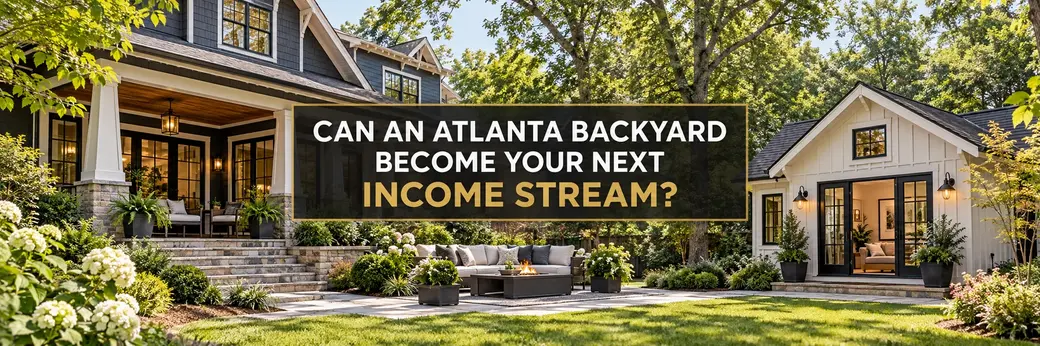
Most homeowners look at a backyard and see lawn, a patio or space they will landscape someday.
An investor may see something else: a second front door, a flexible living space and a potential stream of income.
Accessory dwelling units—often called ADUs, backyard cottages, garage apartments or carriage houses—are receiving attention because they can make one property work harder. In Atlanta, the right ADU may support long-term rental income, accommodate changing household needs, create a private office or add a feature future buyers value.
But the opportunity is not as simple as placing a small house behind a large one.
My view is optimistic and disciplined: an ADU can be one of the most useful investments an Atlanta homeowner makes, provided the parcel is eligible, the design protects the main home and the financial plan works without relying on perfect occupancy or an inflated resale estimate.
Atlanta allows ADUs—but not on every parcel
The first question is not how much rent the unit might produce. It is whether the property can legally support it.
Atlanta’s Department of City Planning says detached ADUs can currently be built by right in the R-4, R-4A and R-5 zoning districts, as well as in certain Special Public Interest and historic districts. “By right” means a zoning variance is not generally required, but it does not eliminate building permits, plan review or other applicable approvals. The city is considering broader ADU reforms, but proposals should not be confused with rules already in effect. Atlanta Department of City Planning
Exact parcel research matters. Atlanta’s online tools can identify zoning, future land use and special restrictions, while the permit portal can reveal current and historical activity. Historic districts, BeltLine overlays and other special areas may add review requirements. Atlanta, GA
The lesson is simple: never buy a property—or approve a design—because a nearby owner built an ADU. Two lots on the same street can have different constraints.
The strongest return may be flexibility, not rent alone
Rental income is the obvious attraction, but it is only one possible return.
A well-planned ADU can serve as:
- A long-term rental
- A private home office or studio
- Guest accommodations
- Space for a caregiver or changing household needs
- A downsizing option that allows the owner to rent the main residence later
- A future selling feature for buyers who value separate, flexible space
That flexibility can be meaningful even when no rent is collected. A design that works only as a specialized rental is more vulnerable than one that can adapt as the owner’s life changes.
The best design question is not, “How many beds can fit?” It is, “How many credible uses can this space support over the next 10 or 20 years?”
Run the numbers before drawing the floor plan
An ADU is a small building project, not passive income purchased in a box.
Start with realistic local rent evidence, then subtract the costs required to earn it:
- Design, surveys, engineering and permitting
- Site preparation, tree protection and drainage work
- Construction and contingency reserves
- Utility connections or upgrades
- Financing costs
- Insurance and property-tax effects
- Repairs, turnover and vacancy
- Property management, if used
- Furnishings and utilities for certain rental strategies
Use a conservative formula:
Annual rent − vacancy − operating expenses − financing costs = estimated annual cash flow
Then stress-test it. What happens if construction costs rise 15%, the unit sits vacant for two months or achievable rent is 10% below the optimistic estimate?
If the project works only at the highest projected rent with uninterrupted occupancy, it is not yet a durable wealth-building plan.
Financing and appraisal require their own strategy
Homeowners sometimes assume future rent will automatically help them qualify for the project or that construction cost will be added dollar for dollar to the home’s value. Neither assumption is safe.
Fannie Mae permits rental income from an ADU on a qualifying one-unit principal residence under defined documentation and underwriting rules. Its guidance may require an appraisal and a comparable rent schedule, depending on the loan and circumstances. Fannie Mae
Fannie Mae also requires an appraiser to describe an ADU and analyze its market effect. The appraiser looks for evidence—not the owner’s construction invoice—to determine value. Fannie Mae
Before committing, compare a renovation loan, home-equity product, cash and other available financing with qualified advisers. Model both monthly cash flow and the effect of tying more capital to the property.
The site can make or break the opportunity
A generous backyard does not guarantee an easy build.
Setbacks, building height, lot coverage, access, parking, easements, topography, stormwater and mature trees can shape or limit the project. Utility routing across an established landscape can also change the budget quickly.
Atlanta states that construction, additions and accessory structures generally require permits unless specifically exempt. The applicable zoning district and overlay determine whether additional approvals—such as a Special Administrative Permit or historic review—are necessary. Atlanta, GA
Good design should protect privacy, light and outdoor utility for both homes. An ADU that overwhelms the yard or creates awkward circulation may produce income while weakening the main residence.
Long-term rental and short-term rental are different businesses
Do not build around nightly-rental projections without verifying the law and the operating reality.
Atlanta requires a license for qualifying short-term rentals and requires the license number to appear in advertisements. The city’s program includes eligibility and operating requirements that should be reviewed directly before choosing that strategy.
A long-term lease may offer steadier occupancy and simpler operations. A furnished mid-term strategy may serve a different demand. A short-term rental may produce higher gross revenue but also requires cleaning, marketing, guest communication, furnishing, utilities and greater management.
Compare net income, not the most exciting nightly rate.
Build it as housing, not merely as a revenue line
Quality matters. Natural light, privacy, storage, safe access, durable materials and thoughtful outdoor space can improve both rental performance and long-term marketability.
Owners who rent the unit should use written, objective screening standards and follow federal, state and local Fair Housing requirements. Decisions should be based on lawful financial and tenancy criteria—not assumptions about who belongs in a particular home or neighborhood.
Keep plans, permits, inspections, warranties and utility records organized. Documentation helps a future buyer, appraiser, lender and insurer understand what was built and why it deserves value.
A practical Atlanta ADU test
Before moving forward, confirm five things:
- Legal feasibility: Verify the parcel’s zoning, overlays and required approvals.
- Physical feasibility: Obtain a site plan and evaluate setbacks, access, utilities, trees and drainage.
- Financial feasibility: Price the full project with contingency and conservative rent.
- Operating feasibility: Choose a realistic rental or personal-use strategy and understand its rules.
- Exit feasibility: Ask how the unit will be documented, appraised, insured and marketed when the property is sold.
The bottom line
Yes, an Atlanta backyard can become an income stream. More importantly, it can become a flexible asset that helps one property serve several chapters of ownership.
The opportunity is strongest when the ADU is legal, adaptable, well-built and financially sound before rent is ever collected. The objective is not to squeeze another structure onto the lot. It is to create housing that strengthens the property, supports the community and gives the owner more options.
If you are considering an Atlanta home with ADU potential—or deciding whether to build on a property you already own—Jules Harper and The Four Walls Group can help you evaluate the real estate strategy, assemble the right local professionals and keep the long-term value in view.
The best backyard investment does more than create rent. It creates choices.
Categories
Recent Posts