
The Finished Basement Mistake That Can Cost Cobb County Sellers
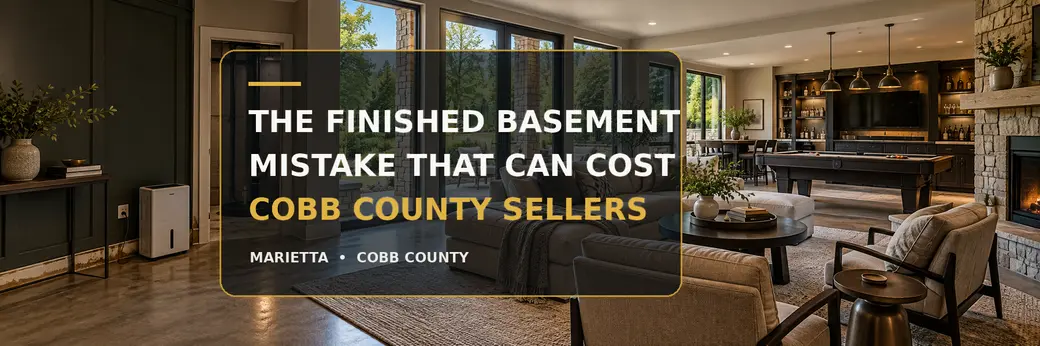
The basement has a theater, a wet bar, a home gym and what looks like an extra bedroom. The renovation cost six figures. Surely the sale price should rise by nearly the same amount.
Not necessarily.
In Cobb County, a finished basement can be one of a home’s strongest selling features—or the place where a buyer, inspector, appraiser and lender begin asking expensive questions.
The uncomfortable truth is that beautiful finishes do not settle the questions that matter most: Was the work permitted? Is the space dry? Can the claimed bedroom be supported? How will the appraiser report the square footage? And do comparable sales prove that buyers will pay the premium?
My view is clear: the biggest basement mistake is treating renovation cost as guaranteed resale value. A basement earns its contribution only when the space is credible, functional and supported by the market.
Below-grade square footage is not counted like the main level
This is the surprise that creates the most disappointment.
Fannie Mae’s appraisal guidance requires appraisers to report above- and below-grade areas separately. If any portion of a level is below grade, Fannie Mae considers that level below grade—even if it is a bright walk-out with large windows and excellent finishes.
That does not mean the basement has no value. Fannie Mae specifically notes that finished below-grade rooms can add substantially to a property’s value. The appraiser reports and adjusts for them on a separate line using relevant market evidence. Fannie Mae Selling Guide
The practical implication is important. A 3,000-square-foot home with 1,200 finished square feet below grade should not be marketed or valued as though it were identical to a 4,200-square-foot home with all finished area above grade.
Sellers can—and should—showcase the full usable space. The numbers simply need to be presented accurately.
An expensive renovation invoice is not an appraisal formula
Appraisers do not usually add the contractor’s invoice to the home’s value. They study how the local market reacts to the feature.
The strongest evidence may be recent sales of similar Cobb County homes with comparable walk-out basements, finish quality, bathrooms, ceiling height, natural light and access. A dark partial basement with a basic recreation room does not compete directly with a professionally finished terrace level opening to a pool and outdoor-living area.
This is where over-improvement becomes dangerous. A homeowner may spend $175,000 creating a highly customized wine room, theater or recording studio. Buyers may love it, but the available sales may support only part of that investment.
The renovation can still be worthwhile for years of enjoyment. It should not be financed or priced on the assumption of a dollar-for-dollar return.
Missing permits can turn excitement into doubt
Basement projects often involve more than drywall and flooring. Electrical circuits, plumbing, HVAC, structural changes and new sleeping areas may trigger permits and inspections.
Cobb County directs owners and contractors to its residential permitting process for applicable work, while properties inside Marietta’s city limits are handled by the city. A Marietta mailing address does not always mean the property is inside the incorporated city, so confirm the governing jurisdiction before requesting records. Cobb County Building and Development City of Marietta
An undocumented renovation is not automatically worthless, and an appraiser identifying an unpermitted addition must consider the quality, appearance and effect on market value. Still, missing records can create uncertainty about safety, insurability and what a buyer may need to correct later.
Before listing, pull the permit history. Compare it with the actual space. If something does not align, speak with the proper building department and qualified professionals before promising a simple solution.
A staged bed does not automatically create a bedroom
Calling a room a bedroom can affect buyer expectations, occupancy plans, septic assumptions where applicable and the way the home is compared with competing listings.
Basement sleeping rooms can raise questions about emergency escape and rescue openings, ceiling height, heat, ventilation, access and local code compliance. The answer depends on the property, construction date, jurisdiction and work performed.
Do not rely on a previous listing’s bedroom count or the fact that a bed fits in the room. Verify the applicable requirements and market the space accurately. “Flex room,” “office” or “guest space” may be more defensible than an unsupported bedroom claim.
Accuracy does not diminish the home. It protects the transaction from a credibility problem during inspection or appraisal.
Moisture can erase the luxury story in minutes
Buyers forgive many cosmetic choices. They become far less relaxed when they smell dampness or see staining near a baseboard.
Basement moisture may relate to grading, gutters, downspouts, foundation cracks, plumbing, groundwater, failed waterproofing or indoor humidity. Fresh paint and new carpet can make the room photograph beautifully without correcting the source.
Before listing, investigate warning signs such as:
- Musty odor or persistent high humidity
- Efflorescence, peeling paint or darkened trim
- Swollen flooring or recently replaced sections
- Sump-pump problems or missing discharge records
- Water marks near doors, windows and mechanical rooms
- Landscaping or downspouts directing water toward the foundation
A dehumidifier can be sensible maintenance. It should not be used to disguise an unresolved water problem. Sellers should disclose known material issues as required and retain invoices, warranties and transferable documentation for corrective work.
Radon belongs in the conversation
Radon is a naturally occurring radioactive gas that can enter buildings from the ground. The EPA recommends testing all homes below the third floor because maps cannot determine the level in an individual property. Testing is the only way to know the home’s radon level. U.S. Environmental Protection Agency
For a basement used as daily living or sleeping space, this is not a detail to postpone. A seller may choose to test before listing so the result and any mitigation can be addressed deliberately. Buyers should consider their own testing within the contract and professional guidance.
Radon mitigation is a recognized building service, not a reason to panic. The expensive mistake is assuming a beautifully finished room has already answered an invisible environmental question.
What Cobb County sellers should do before listing
Treat the basement like a small property within the property.
- Verify jurisdiction and permits. Confirm whether the home is governed by Cobb County or a municipality, then obtain the available permit and inspection history.
- Measure and describe accurately. Separate above-grade living area from finished below-grade space in marketing.
- Review every room claim. Do not label a basement room as a bedroom without appropriate support.
- Investigate moisture. Resolve sources—not merely stains—and organize repair records.
- Consider radon testing. Address the result with qualified professionals if needed.
- Study basement-specific comparable sales. Compare finish quality, light, walk-out access, bathroom count and utility.
- Price the contribution, not the invoice. Let market evidence determine how much value the basement adds.
Buyers should look past the staging
A finished basement can provide extraordinary flexibility: work space, recreation, multigenerational gathering, fitness or storage. Evaluate those objective features without making assumptions about who should live in a home or community.
Then ask for permits, inspect for moisture, verify claimed uses, review insurance implications and understand how the lender’s appraisal treats the space. A basement can be a genuine asset even when it is reported separately. What matters is paying for the value that actually exists—not the value the renovation story implies.
The bottom line
The best finished basements in Marietta and Cobb County absolutely can strengthen marketability and resale value. But luxury materials cannot outrun missing documentation, unsupported room counts, unresolved moisture or weak comparable evidence.
If you are preparing to sell a home with a finished basement, Jules Harper and The Four Walls Group can help you audit the value story, identify questions before buyers do and position the property with accuracy and confidence.
A basement should expand the life a home can hold—not create the question that makes a buyer step back.
Categories
Recent Posts