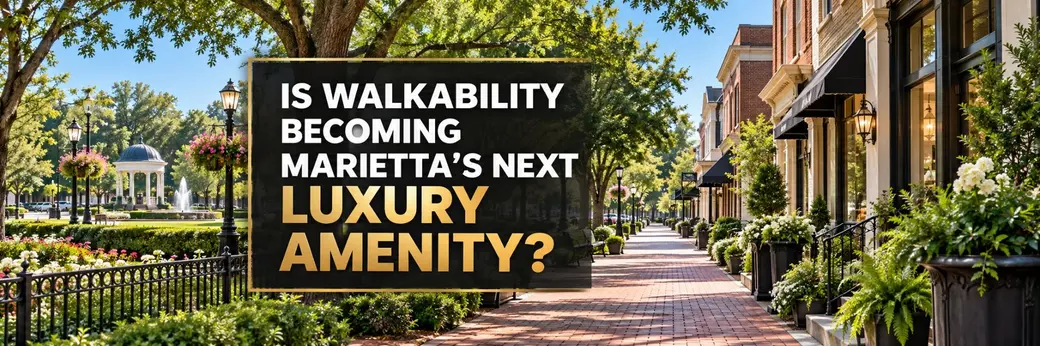
Is Walkability Becoming Marietta’s Next Luxury Amenity?
For years, the suburban luxury formula was straightforward: more square footage, a larger lot, a three-car garage and enough distance from activity to feel private.
Those features still matter. But another amenity is becoming increasingly difficult to reproduce—and increasingly desirable.
The ability to leave the car at home.
In Marietta, a home that connects easily to the Square, a park, a trail, dining, arts or everyday services may offer something buyers cannot add during a renovation. Kitchens can be remodeled. Closets can be expanded. A genuinely walkable location is fixed.
My view is that walkability is becoming a form of practical luxury in Marietta—not because every buyer wants the same lifestyle, but because time, convenience, recreation and connection have real value.
The national demand is no longer subtle
The National Association of REALTORS® surveyed 2,000 adults across the country’s 50 largest metropolitan areas in May 2026. The results were decisive: 89% said sidewalks and places to walk were important when deciding where to live, while 82% valued being within an easy walk of shops and parks.
Nearly two-thirds—63%—said they would pay more to live in a community where they could easily walk to parks, shops and restaurants. When given a choice, 59% preferred a smaller lot in a walkable neighborhood over a larger homesite requiring more driving. nar.realtor
Those are national preferences, not a promised Marietta price premium. Yet they help explain why proximity is becoming part of the value conversation alongside bedrooms, condition and school assignment.
The market is not abandoning space. Buyers are expanding their definition of what makes a home feel luxurious.
Marietta has an asset many suburbs are trying to create
Marietta Square gives the city an established center rather than a manufactured gathering place. Glover Park, restaurants, cultural venues, businesses and civic spaces sit within a recognizable downtown framework. Marietta, GA
That center is strengthened by the Mountain to River Trail. The full M2R corridor spans 13.5 miles from Kennesaw Mountain National Battlefield Park toward the Chattahoochee River. Within Marietta, approximately 3.5 miles connect the Kennesaw Mountain area, Wellstar Kennestone, the Historic Downtown Square, Brown Park and the City Cemetery. Marietta, GA
The city’s network is still evolving. On September 18, 2026, Marietta held a groundbreaking for Phase 1 of the Rottenwood Creek Trail at Aviation Sports Complex. The new path is intended to connect the park to the Cemetery Trail and extend toward Marietta Square. Marietta, GA
That matters because walkability is rarely created by one sidewalk. Its usefulness grows when parks, homes, trails and destinations connect into a network.
The real luxury is time returned to the owner
A walkable address does not merely offer exercise. It can convert small trips into experiences.
A resident may be able to walk to dinner, attend an event without reorganizing the evening around parking, reach a trail from home or turn a coffee run into time outdoors. The precise benefits depend on the property and the resident’s needs, but the broader value is choice.
That choice can be especially meaningful when Metro Atlanta traffic makes even a short drive feel unpredictable. A home that places enjoyable destinations nearby can return time to the owner without requiring a larger mortgage for more interior space.
This is why I consider walkability a luxury amenity. Luxury is partly about quality, but it is also about friction. The easier a home makes daily life, the more valuable the experience can become.
Not every “near the Square” listing is truly walkable
Marketing language tends to stretch distance.
“Minutes from Marietta Square” may mean a comfortable walk, a short bicycle trip or a ten-minute drive. Those are three different ownership experiences.
Buyers should evaluate the actual route—not simply the radius on a map:
- Is there a continuous sidewalk or designated trail?
- How many significant roads must be crossed?
- Are crossings controlled and visible?
- Does the route feel practical during ordinary daylight hours?
- Is the terrain comfortable for the intended use?
- Can the destination be reached without walking through parking lots or narrow shoulders?
- Are planned connections funded and underway, or merely conceptual?
Walkability should be measured from the front door, not from the subdivision entrance.
The same discipline supports Fair Housing compliance. Discuss objective distances, transportation infrastructure, services and property characteristics—not assumptions about who belongs in a particular neighborhood.
Sellers should market the route, not just the destination
A seller with a genuinely walkable Marietta property may be under-marketing one of the home’s strongest advantages.
Do more than state that the property is “close to the Square.” Where accurate, identify objective distances and useful connections. Show the sidewalk, trail entrance, park access or route to dining in photography and video. Mention the destinations without implying that every buyer will use them in the same way.
The strongest presentation might include:
- Measured distance to Marietta Square or a trail entrance
- Nearby public parks and cultural destinations
- Continuous sidewalk or multi-use trail access
- Practical walking or cycling routes
- Upcoming publicly documented connectivity improvements
- A map using verified routes rather than a simple circle
This turns an abstract location claim into a property feature a buyer can understand.
Homeowners can strengthen the connection
Owners cannot move the house closer to downtown, but they can improve the transition between home and street.
Useful projects may include a safer front walkway, attractive lighting, secure bicycle storage, a functional porch, better drainage near paths and landscaping that keeps sidewalks clear. In some properties, creating a more inviting entrance can make the home feel connected rather than hidden from the surrounding environment.
Before changing fences, gates, driveways or areas near the right-of-way, verify HOA rules, easements and the appropriate city requirements.
The goal is not to remove privacy. The best design can preserve a sense of retreat while making it easier to engage with the community beyond the property.
Buyers should not overpay for the label
Walkability can strengthen value, but it does not erase the fundamentals.
Buyers should still compare condition, taxes, insurance, lot utility, noise exposure, parking, renovation needs and recent sales. A smaller home near the Square may command a different price than a larger home farther out, but the appropriate premium must come from comparable market evidence—not a national survey or marketing enthusiasm.
The correct question is not, “Is walkability valuable?” The evidence suggests many consumers believe it is.
The better question is, “How much has this specific Marietta market paid for this specific level of access?”
The bottom line
Marietta’s combination of an established downtown, public parks and expanding trail connections gives the city an advantage that cannot be recreated inside the property line.
For some buyers, the larger lot will remain the priority. For others, walking to dinner, a park or a community event will be worth trading a little space. The most resilient properties often offer a thoughtful balance: comfort at home and meaningful access beyond it.
If you are buying or selling in Marietta, Jules Harper and The Four Walls Group can help you evaluate how location, connectivity and lifestyle features translate into a defensible real estate strategy.
The next luxury upgrade may not be inside the home. It may be everything you can reach when you step outside.
Categories
Recent Posts