
Is Buying Beside the Atlanta BeltLine Worth the Disruption?
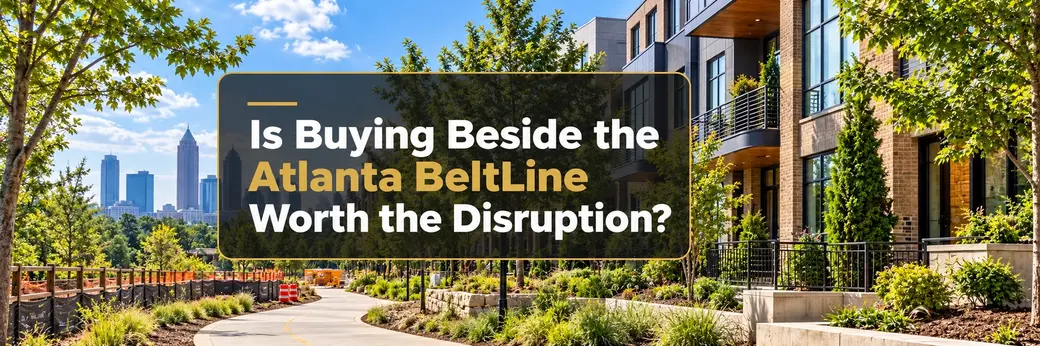
The listing promises a future beside the Atlanta BeltLine: trail access, parks, new destinations and an increasingly connected city.
The current view may be orange fencing, heavy equipment and a construction schedule that has already changed.
Should you buy now and tolerate the disruption, or wait until the vision becomes usable?
My view: buying beside a BeltLine project can be a smart long-term move, but only when the property works at today’s condition and price. A buyer should not pay the full premium for an amenity that remains years away, especially when the exact access point, construction sequence and surrounding development are still evolving.
The opportunity is real. So is the inconvenience.
“Near the BeltLine” can describe very different realities
One Atlanta home may sit beside a completed, landscaped trail with a convenient entrance. Another may be near an interim path. A third may be close to a planned segment but separated from it by a major road, grade change, fence or private property.
Do not rely on the listing’s distance calculation. Walk the route you would actually use. Confirm where the legal public entrance is, whether it is open and what must be crossed to reach it.
Then identify the exact project segment on Atlanta BeltLine maps and read that segment’s current page. Atlanta BeltLine’s strategic plan provides a roadmap toward program completion by the end of 2030, but individual projects have their own funding, procurement and construction sequences. beltline.org
“Part of the 2030 vision” does not necessarily mean “comfortable access next year.”
The timeline may be longer than the listing suggests
Current projects demonstrate how widely schedules differ.
Southside Trail Segments 2 and 3 celebrated a ribbon cutting in June 2026, yet the official project page still identifies corrective stair work and a second phase of landscaping in October. Southside
On the Northwest Trail, Segment 1 remains under construction. Its project page says unforeseen conditions pushed portions of the work into later years, with the Peachtree Creek bridge and northern elevated trail currently expected in mid-2028. Segment 1 design and ...
The Oakland and Murphy Connector Trail presents another schedule: design reached 90% in September 2026, construction is expected to begin in 2027 and completion is projected for 2028, followed by landscaping. beltline.org
These dates are useful planning information, not guarantees. Infrastructure schedules can move because of engineering discoveries, easements, utility conflicts, approvals, procurement or funding.
Ask the seller or developer for support for any timeline they advertise. Then verify it against the responsible agency’s current materials.
Construction affects more than the view
The obvious inconvenience is noise. The more consequential issue may be how construction changes daily use of the property.
Visit at different times and investigate:
- Construction access and truck routes
- Temporary road, sidewalk or driveway changes
- Dust, lighting and work hours
- Parking displacement
- Drainage and grade changes near the lot
- Tree removal and future landscaping
- Temporary and permanent fencing
- The finished trail’s location relative to windows and outdoor areas
A trail that eventually improves connectivity can also change backyard privacy. A home that feels secluded beside an inactive corridor may feel different after regular foot and bicycle traffic arrives.
That is not automatically negative. Some owners value energy and immediate access; others prioritize separation. Price the property for the experience you expect, not the experience marketing assumes everyone wants.
Do not pay twice for the same future
A seller may argue that the coming trail justifies a premium. A builder may price new construction around anticipated demand. Buyers should ask how much of that future has already been captured.
Atlanta’s broader market is selective enough to support a careful comparison. Over the three months ending September 2026, Atlanta homes sold for a median of approximately $424,898, up 10.8% year over year. Sales declined 14.7%, however, and homes took a median of 63 days to sell. redfin.com
Those citywide figures do not establish a BeltLine premium. They show why local comparable sales matter. Compare:
- Homes with completed, convenient trail access
- Homes beside active construction
- Homes advertised as “near” the corridor without practical access
- Similar homes outside the immediate project area
Study closed prices, market time, concessions and resale history. The correct adjustment may be positive, neutral or negative depending on the exact property and phase.
Future development can be a benefit and a risk
New parks, trail connections and commercial activity may expand daily options. They may also bring additional construction, traffic, parking pressure or buildings that affect a home’s light and view.
Use the City of Atlanta’s property-information and planning maps to review the parcel, zoning and available future-land-use information. Then examine nearby development applications and ask appropriate professionals to interpret what can legally be built.
The city’s research tools provide property, zoning and project information, but a map is not a guarantee that a particular proposal will, or will not, occur. gis.atlantaga.gov
Never pay for a skyline view, empty parcel or quiet edge without investigating whether it is protected.
Property taxes belong in the ownership plan
An improving area can support property values while also increasing ownership costs. Estimate taxes from the likely post-purchase assessment rather than assuming the seller’s current bill will continue.
Confirm the applicable county, city and exemption rules for the parcel. Budget for insurance, association dues and special assessments as well.
Atlanta BeltLine Partnership currently describes a Legacy Resident Retention Program that assists qualifying long-time homeowners in designated areas with property-tax increases through tax year 2030. That program is an important community resource, but a new buyer should not assume eligibility. beltline.org
The responsible purchase works without depending on assistance for which the buyer has not received written approval.
Five questions before paying the BeltLine premium
- Which exact segment serves this property? Identify its current phase and responsible agency.
- Where is the usable entrance? Walk the legal route rather than measuring a straight line.
- What will construction change? Investigate access, parking, noise, drainage, trees and privacy.
- What future development is possible nearby? Review zoning, plans and pending projects.
- Does the price work if completion takes longer? Buy a home you can enjoy and afford under present conditions.
Preserve inspection, title, survey and legal-review protections appropriate to the transaction. Trail proximity does not replace ordinary property due diligence.
The bottom line
Buying beside the Atlanta BeltLine can provide an exceptional combination of connectivity, outdoor access and long-term urban appeal. The strongest purchase, however, is not based on a brochure version of the future.
It is based on the exact segment, exact entrance, exact property and a price that acknowledges the construction still ahead.
If you are comparing Atlanta properties near the BeltLine, Jules Harper and The Four Walls Group can help you investigate the practical access, current competition, development context and resale story before you pay for the promise.
Buy the location you can live with today. Let tomorrow’s progress become the upside.
Categories
Recent Posts