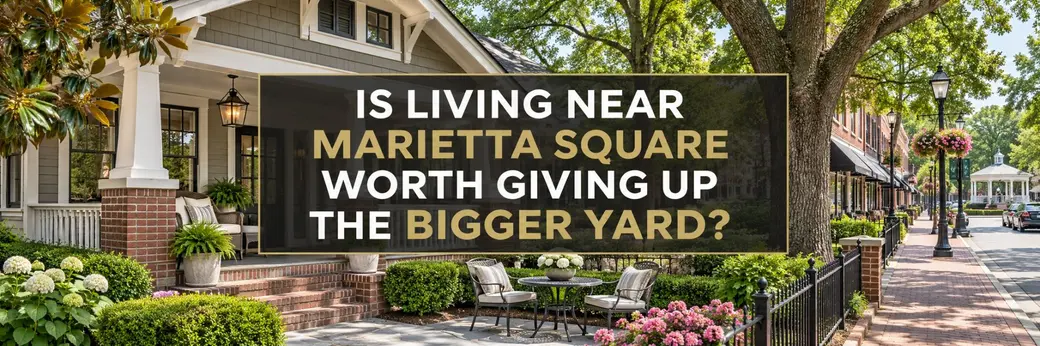
Is Living Near Marietta Square Worth Giving Up the Bigger Yard?
The house farther out offers another bedroom, a wider driveway and enough backyard for a pool, a garden and a dog with serious ambitions.
The house near Marietta Square offers less land, tighter parking and the possibility of walking to dinner, concerts, festivals, shops and a trail that reaches beyond downtown.
Which property gives you more?
That depends on whether you are buying square footage or buying back time.
My view is that living near Marietta Square can justify a smaller yard and even a higher price per square foot—but only when you will use the location regularly and the property still satisfies your nonnegotiable needs. Walkability is valuable when it changes daily life. It is expensive decoration when it appears only in the listing description.
The Square offers a real lifestyle advantage
Marietta Square is not simply a landmark buyers drive past. The City describes it as a central gathering place built around Glover Park, with restaurants, shopping, museums, theatres, markets, festivals and concerts. Marietta, GA
The Mountain to River Trail adds another layer. Within Marietta, it runs approximately 3.5 miles from Kennesaw Mountain through the Kennestone area and Historic Downtown Square before continuing to Brown Park and the City Cemetery. The broader trail system is designed to connect with destinations beyond the city. Marietta, GA
For a buyer who regularly uses those amenities, proximity can replace some driving, parking searches and planning. That convenience may support long-term satisfaction in ways an extra formal room does not.
But “near the Square” is not a standardized measurement. A property may be a pleasant ten-minute walk away, or it may require crossing a busy road without the route a buyer imagined. Walk the exact path at the times you expect to use it.
A smaller yard may be a feature, not a sacrifice
Large lots provide privacy, recreation, gardening and future project space. They also require mowing, leaf management, drainage work, irrigation, tree care and money.
Some buyers actively want that responsibility because the land supports how they live. Others are paying for a yard they mostly view through a window.
Before treating lot size as automatically better, ask what the land must accomplish:
- Is there enough usable outdoor space for dining, pets, gardening or play?
- Is the lot level and functional, or is much of it occupied by slope and drainage?
- What will routine care cost in time and money?
- Does the property offer a porch, courtyard or nearby park that supports the desired use?
- Would you trade part of the yard for a shorter drive to the places you visit most?
A compact, well-designed outdoor area can be more useful than a large yard with poor access or expensive maintenance.
Do not pay a walkability premium for a driving lifestyle
This is the uncomfortable part.
Buyers sometimes fall in love with the idea of walking to coffee while continuing to drive almost everywhere after closing. Work schedules, weather, mobility needs, carrying groceries and the location of personally important services can make the imagined routine unrealistic.
Conduct a “normal Tuesday” test before assigning value to proximity.
Map the buyer’s actual workplace, grocery options, healthcare, recreation and other frequent destinations. Visit the property during the morning commute, an ordinary evening and a major downtown event. Observe traffic, sound, lighting, sidewalks and the return walk after dark.
The Square may dramatically improve one household’s routine and barely affect another’s. That is a personal-use calculation, not a judgment about who should live in a particular area.
Parking is manageable—but it still belongs in due diligence
Downtown Marietta provides a mix of free and paid parking. The City currently lists two-hour free on-street spaces, time-limited city lots, evening and weekend access at certain public lots and decks, and privately operated paid parking. Marietta, GA
That supports visitors. A homeowner has a different question: where will residents and guests park every day?
Verify the property’s driveway, garage dimensions and legal on-street conditions. For a condominium or townhome, examine assigned spaces, guest rules, towing policies and any parking-related association restrictions.
Do not assume public event parking will function as dependable residential overflow.
Historic character may come with exterior rules
One of the area’s strongest assets is its architectural character. That character is not preserved by accident.
Marietta has locally designated historic districts, including Kennesaw Avenue, Church-Cherokee Streets and Forest Hills. Properties inside a local district may require a Certificate of Appropriateness for exterior work. Marietta, GA
The City’s preservation process can address exterior changes such as materials, additions, paint, windows, porches or demolition, depending on the property and project. Interior work is generally a different matter, although ordinary permits may still apply. Marietta, GA
Buyers should confirm whether the exact parcel is within a local historic district and review the applicable rules before budgeting an exterior renovation. Do not assume that a previous owner’s alteration proves current approval.
The rules can protect neighborhood character and resale appeal. They can also affect timing, design freedom and cost.
The market gives buyers room to compare
Over the three months ending September 2026, Marietta homes sold for a median of approximately $431,295, down 1.2% from a year earlier, and took a median of 48 days to sell. Realtor.com’s separate September summary reported active listings up 8.4% year over year and a 99% sale-to-list ratio. Redfin
These are broad city and portal statistics, not a valuation for homes around the Square. They indicate a market where buyers can compare alternatives rather than treating every in-town property as a now-or-never opportunity.
To evaluate a location premium, compare homes with similar condition, architecture, parking and renovation quality at different distances from the Square. Study closed prices, concessions and market time—not just asking prices.
The premium should be supported by both market evidence and the value the location creates for the buyer.
Five questions before choosing proximity over property size
- How often will I actually walk? Base the answer on weekly routines, not vacation behavior.
- What does the smaller lot prevent? Identify specific lost uses rather than assuming bigger is better.
- What will I save in time and maintenance? Give convenience an honest value.
- What activity comes with the location? Evaluate traffic, events, parking and sound at realistic times.
- Will the next buyer understand the tradeoff? Favor functional parking, usable outdoor space and documented improvements.
The bottom line
Living near Marietta Square can deliver something additional square footage cannot: spontaneous access to the center of the community and less friction between home and the places you enjoy.
That can absolutely be worth a smaller yard.
But the location should improve your real routine, not merely your description of the house. Walk the routes, price the maintenance, understand parking and historic requirements, and compare the premium with alternatives that offer more land.
If you are deciding between an in-town Marietta home and a larger property farther out, Jules Harper and The Four Walls Group can help you compare the complete lifestyle, ownership costs and resale evidence behind each option.
The better property is not always the one with more land. Sometimes it is the one that puts more of your life within reach.
Categories
Recent Posts